
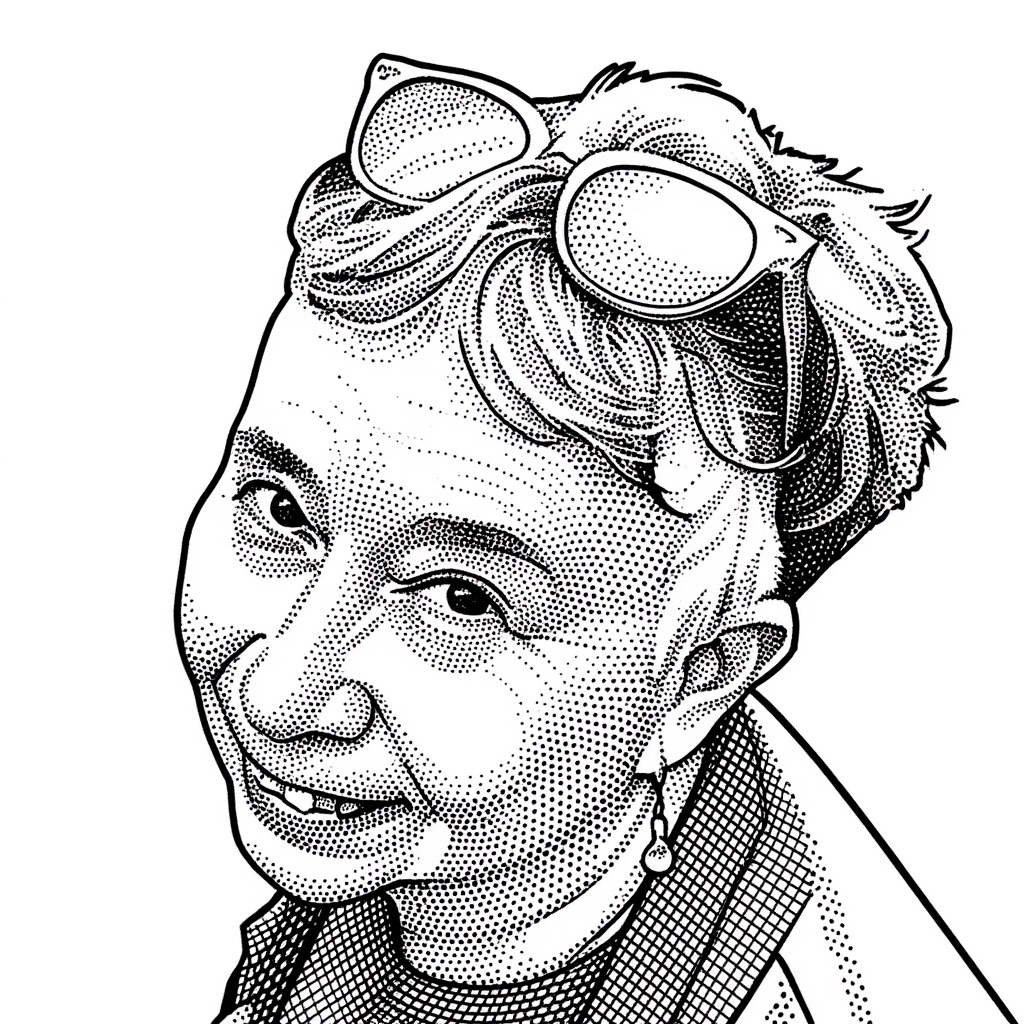
Rita Collins had taught school for decades when she started fantasizing about opening a bookstore once she retired. The American Booksellers Association told her it wouldn't work: her town in northwest Montana was too small to sustain one. Undeterred, Rita and her friends dreamt up a mobile version instead. She bought a used van, a friend designed the interior, and everyone she knew donated books. For not a lot of money, she hit the road, setting up at farmers markets, fairs, and other stops across the U.S. She chatted with us from her home in Baltimore between trips.
We love the name: “Saint Rita's Amazing Traveling Bookstore and Textual Apothecary.” How did you choose it?
Saint Rita is the patron saint of impossible causes. I heard about her when I lived in the Czech Republic. They celebrate name days there, and on Saint Rita's Day in May, the church is filled with roses. It was very memorable.
Years later, when I was thinking about starting the bookstore, I thought about Saint Rita. I didn't really know anybody in the U.S. with a traveling bookstore, I was on my own, and I was starting as an older person. It felt right.
And then I decided it should feel like an old-time medicine show. Have a headache, have a cold — you read and you feel better. It’s medicinal, that’s why I added “textual apothecary.”

Photo by Christopher Myers
What concerns were on your mind as you set out on your solo adventures?
The first time I thought I would run out of books, so I put a lot of energy into finding places along the way where people would stockpile books for me to pick up as I went. But the reality is that people are constantly giving me books. After that first trip, I realized I don't have to plan for that.
For the trip they wrote about in The New York Times, I left with about 700 volumes in the bookstore and 200 more in a little storage space in the back. I was on the road for six weeks, twenty-four gigs, sold tons of books, and all along the way people kept giving me more. I came back with as many books as I left with, if not more.
Do you feel you have a front-row seat to a divided America, or are we more connected than we think?
People who come to the bookstore seem excited about reading and excited about the bookstore. Even though we can have conversations about what's going on in the country and lament the divisions, I don't feel it is directed at me or my bookstore. A couple of times people have asked about banned books, but when they weren't able to give me a list, it was okay.
There's something unique about a traveling bookstore, specifically. When I told people I was going South for six weeks, people said, “Oh my goodness, that's going to be so scary.” And it was a wonderful, wonderful experience.
And when I was there, they'd ask where I live, and I'd say Baltimore, and they'd say, “Baltimore, isn't it full of crime?” Well, no, actually it isn’t.
I am witnessing different parts of the country that people don't visit. Many people from the West Coast haven't been to the South, or people in the South may not have been to Baltimore or Seattle. And because I get to go to all these places — and I stay with people when I'm on the road, I don't stay in hotels — I'm meeting people in the community as well as people who come up to buy books. I get a really good snapshot of America.
What are some of the most popular books you carry?
Kids' books, because mine are a dollar apiece. Families really like to buy them — that makes me happy. And then probably novels, I try to maintain a nice selection of fiction.

Photo by Rita Collins
What’s been the role of reading in your life?
I grew up in a large family, but we were always going to the library and bringing home piles of books. Later I was fortunate to go to St. John's College, which is based on reading. That was the perfect school for me. And then I worked in literacy for a while, volunteering, teaching kids to read, helping adults work on their reading skills.
I've always been enthralled with reading and what reading can do for people. So I thought, when I move on from teaching, wouldn't it be nice to have a bookstore — here I am. And now I feel completely justified reading as many books as I can possibly fit into a day. It's part of my job. I have to make sure they're good books. [Laughs]
What kind of books do you like to read?
All kinds. Right now I'm reading The Fabric of Civilization — it's about how people first started making thread, and how the idea developed to weave it or sew it or knit it to make fabric. Six miles of thread to make one pair of jeans. I think anybody who starts it would be like, my goodness.
I'm also reading The Gift of Years, which is about aging. I'm at a point where I'm aging, but there's so much cultural pushback about getting older, and I really like reading people's insights on that.
And I just started The Elegance of the Hedgehog; somebody donated it and I'd forgotten how much I enjoyed it.
I also just finished The Whalebone Theatre and Taiwan Travelogue.
I go through a lot of books in a week.
What are your favorite books of all time?
It changes with time, but The Plover by Brian Doyle. Being Mortal, which is about quality of life and thinking about what you want at the end. Karen Hesse's Witness and Out of the Dust. The picture book The Araboolies of Liberty Street. Girl, Woman, Other, which won the Booker a few years back. It's so many different books in different moods and situations.
What books do you like to gift?
When I lived in Montana, I gave a book of photographs and journals of Montanan Evelyn Cameron a lot. Since I've moved to Baltimore, it doesn't fit as well.
Now it's more about the person. I just found a book about women leaders and their photos that I'm sending to a woman who does woodblock prints of women in Montana. And I'm sending a graphic novel by Baltimore author Nguyên Khôi Nguyễn to someone who's never read a graphic novel before. So it's always: who is the person, what is the occasion, what book seems like a good fit.
Do you have any rituals around reading?
I’m a print books person, and my only routine is to read whenever I can. I typically have something to read with me if I'm traveling or waiting for an appointment. I think my only real routine is squeezing in as much reading as possible in any one day.
Do you ever feel sad about the way society is going in terms of reading?
Yes. I hear people talk about how statistically many people haven't read a book in the last year. But when I'm out with my bookstore, I see so many kids and teenagers coming in to get books. I have a whole zine collection now that I didn't have a year ago, because young people are coming. I'm very optimistic.

Photo by Rita Collins
One of the big pluses of this particular bookstore is that it sets up in so many places. You don't have to make a trip to a bookstore because the bookstore is at the farmer's market, or parked at the diner, or at a brew pub, or at your kids' school. It's just there. It makes it so easy for people to say, “Here's a book and I want it.”
Is there anything that you'd like people to know?
I think more people should start traveling bookstores. This is a really difficult time in this country — I'm sure you'd find very few people who disagree with that. But I think traveling bookstores can make a difference, just in getting people to talk together and making books available to all different kinds of people.
I started with no background in business. I think anybody who knows how to drive, likes people, and has friends who will donate books — you can do it. You don't even need a van. I once did an entire trip out of my Subaru Crosstrek when my van broke down the day before I was leaving. A Subaru Crosstrek is not a large car, and I fit a table, two chairs, two carry-on suitcases, and enough books to manage a full trip. So you don't even need a van to get started. You just need a sign, books and a willingness to set up.
To learn more about Rita’s travels, find her on social media and via her website.
Download Margins to join a community of people tracking and sharing their love of books.
