
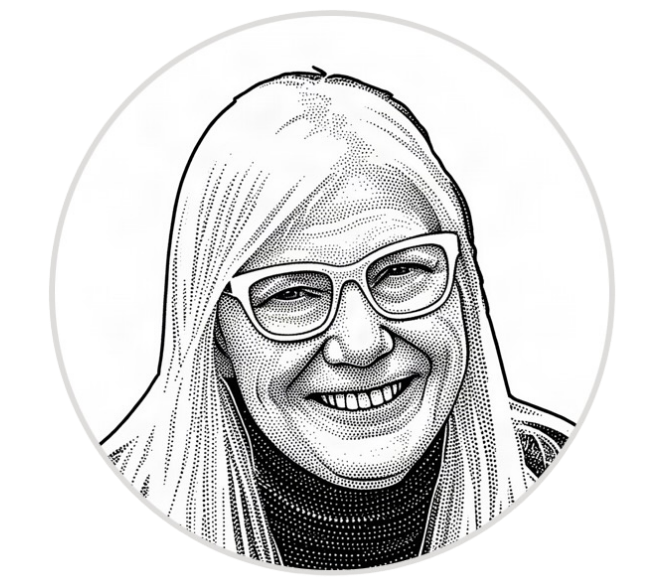
Devoney Looser has been reading Jane Austen for 40 years and built her whole life around the writer. She’s currently a Regents Professor of English at Arizona State University and the author of Wild for Austen: A Rebellious, Subversive, and Untamed Jane, and she used to skate roller derby as “Stone Cold Jane Austen.” Looser’s take is that most people misunderstand Austen as mild and boring when really she’s remarkably sharp, funny, and complex.
Why are you fascinated with Jane Austen?
Jane Austen has been a favorite author since I was a teenager in the early 1980s. She was one of the few authors that I not only enjoyed reading but enjoyed re-reading, and that’s still true! I see something new in her novels every time I read them. It’s been the great gift of my life to be able to read, research, write, and teach about Austen. She not only made possible work that I love: my first conversation with the man who became my husband was an argument over Jane Austen. (He’s also an Austen scholar.)
What’s the biggest misconception about her, and what should people know instead?
There are so many myths about Austen that there’s actually a terrific book debunking them, 30 Great Myths About Jane Austen. The myth that strikes me as the greatest misconception about her is that she was (and her fiction is) mild and boring. I wrote a book, Wild for Austen, trying to move the dial from misunderstanding her as mild to grasping how she and her fiction might rightly be characterized as positively wild.
Which novel is most underrated, and do you have a favorite line or quote?
That’s a tough one. I mean — none of the six major novels are underrated exactly, are they? They are seen as some of the greatest novels written in English. But I believe Northanger Abbey deserves to be better appreciated and deserves more readers than it gets. A favorite quote from that novel is from its naive heroine Catherine Morland. She says, “I cannot speak well enough to be unintelligible.”
Why do readers keep coming back to her books two centuries later?
Because her novels are works of genius, and that’s true on the level of the sentence, the paragraph, the chapter, the character, the plot. The novels are beautifully crafted, and the characters and the stories just continue to resonate with us, don’t they? It’s not just because they are love stories. They’re so much more than that. As I like to say to my students, her novels explore how to live a meaningful life in a world that’s deeply unfair. And they do that while being remarkably funny.
What do you notice in her work now that you missed when you first started reading her?
When I first started reading Austen, I understood that there were things in the novels that were very funny. I didn’t understand the extent to which the novels were filled with irony and social criticism. Now that I study the literature of her contemporaries and the Regency period for a living, lines of hers that didn’t mean much to me on a first reading now strike me in new ways. Almost every line in Austen is multi-layered!
Do you annotate your Austens? Any (re)reading rituals?
I do annotate them. A few years ago, I edited a book, The Daily Jane Austen: A Year of Quotes, which meant I needed to choose the best 378 quotations from her writings. (That’s 366 days plus longer quotes for each of the 12 months.) I marked up my editions looking for the best lines. What I can tell you is that it was difficult to choose just 378 quotations!
Austen titles are climbing on our reader charts ahead of Netflix’s Pride and Prejudice on December 3. What do adaptations get right or wrong about her work?
I’d rather think of it as what they do to reimagine the originals, rather than right or wrong. I know we all have our preferences for what makes a great adaptation, but I love it when a film or a series retains a good deal of Austen’s great dialogue and when they find new ways to express humor. Some of Austen’s humor translates, but some of it doesn’t. For instance, in Northanger Abbey, the ridiculous John Thorpe makes fun of his mother’s “quiz of a hat.” Most people don’t know what that means. So in cases like that the screenwriter and director need to find new ways to communicate the humor of the character and scene. Most of all, whatever they change, I just want the new material to be smart!
What are you hoping to see in the new series, and what do you watch for in any adaptation?
I’m excited about what I’ve seen from the trailer and the pre-release interviews. I’m looking forward to seeing Emma Corrin and Jack Lowden’s chemistry on screen. Screenwriter Dolly Alderton has suggested that Lowden’s Darcy is bringing new levels of humor and physicality to the part, which is intriguing. They aren’t yet touting what Corrin’s Elizabeth is bringing that’s new, but whatever it is, I think I’m there for it? I’m also really eager to see Olivia Colman and Rufus Sewell playing Mrs. and Mr. Bennet. They are such great actors. If the script is as good as I hope it is, then these two are going to set these parts on fire.
How did “Stone Cold Jane Austen” come about, and does it change how you read or teach her?
Ha. I did write about this in my last book, Wild for Austen! “Stone Cold Jane Austen” is my roller derby name. (I’m no longer competing, but I’m still the faculty adviser to Arizona State University’s roller derby team, so I love to say that roller derby is officially a part of my job.) It came about when a special collections librarian and a graduate student let me tag along to the roller rink with them, we were recruited by the local roller derby team, and the librarian friend suggested the name for me. It changed how I think about and teach Austen, I think, by allowing me to be more open to the ways she is wild. I love that, in her letters, she writes, “If I am a wild beast, I cannot help it. It is not my own fault.” It was a treat to write a chapter in Wild for Austen about what she might have meant by that funny line.

“Stone Cold Jane Austen” Photo credit: Alex Chapin and the ASU Board of Regents
Which other writers do you think people should check out, contemporary or classic, if they love Jane?
I like to teach Jane Austen’s novels alongside those of her contemporaries. So reading Jane West’s A Gossip’s Story alongside Austen’s Sense and Sensibility (1811). Mary Hays’s The Victim of Prejudice (1799) alongside Austen’s Pride and Prejudice (1813). Charlotte Lennox’s The Female Quixote (1752) alongside Austen’s Northanger Abbey (1818). The anonymous The Woman of Colour (1808) alongside Austen’s unfinished Sanditon. It gives you a real appreciation for what she achieved. Rebecca Romney’s informative and entertaining Jane Austen’s Bookshelf is a great way to get a sense of which of her other contemporaries you might want to read, too.
What do you think Jane Austen would make of the world today?
Wow. What would anyone from the early 1800s make of the world today? One clue for me is how Austen writes about Elizabeth Bennet. She describes her as having “a lively, playful disposition, which delighted in anything ridiculous.” I would like to think Austen, if she had to observe 2026, might bring some of that energy herself.
You can follow Devoney on Substack, where she has a newsletter about history’s strong women. Learn more about her on her website.
